
Everyday phrases 3 — Why not?
How to offer and accept a drink (e.g. at a party or in other social situations).

Read post 2 here
Today we’ll continue discussing social situations — more on offering and accepting something.
Today’s mini-dialogue:
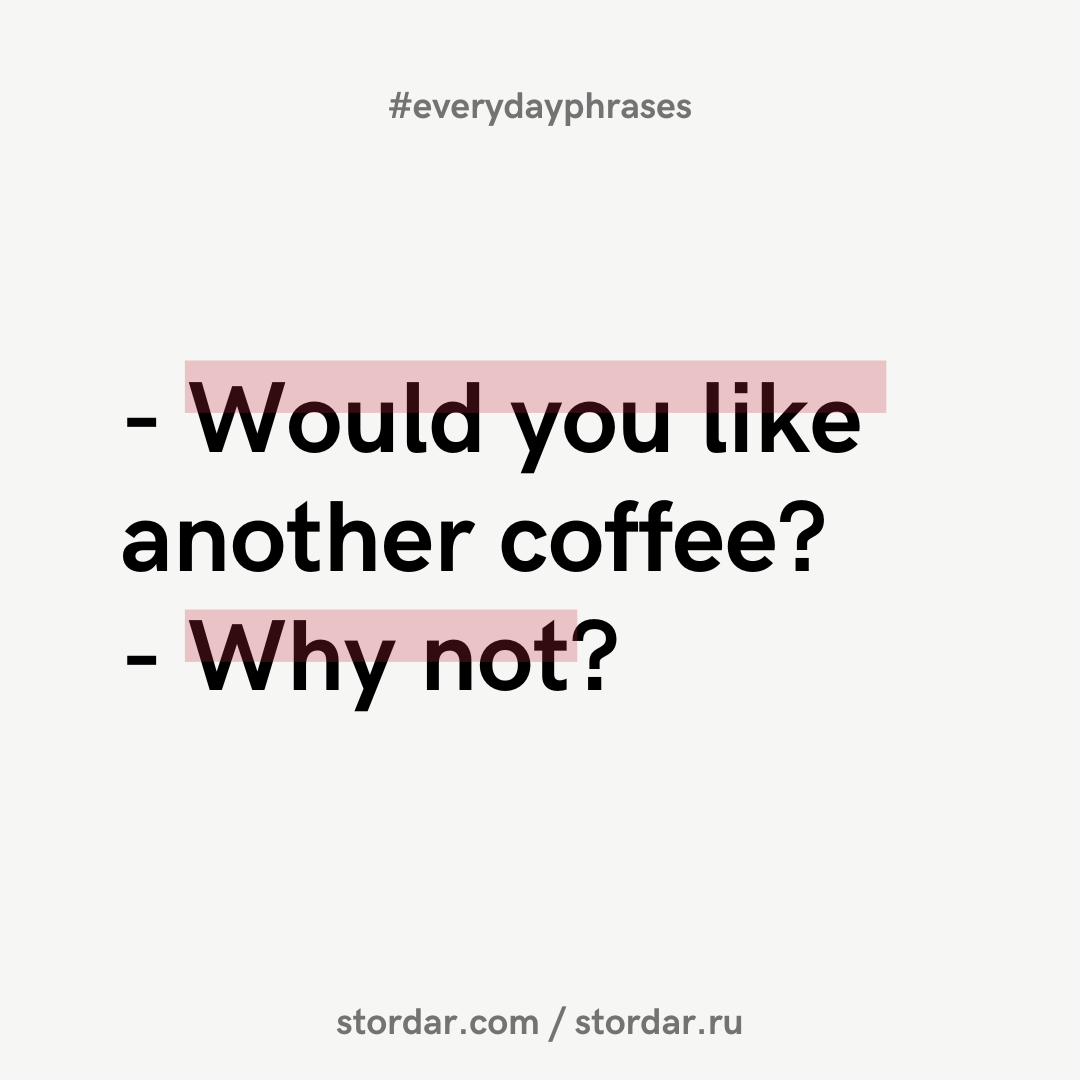
Would you like another coffee ☕?
Why not?
What you need to remember
The question Do you want…? is too direct and is used only in communication with close friends and members of your family. For formal and semi-formal communication (with less familiar people), use a more polite formula Would you like…? to offer something.
How to offer something to somebody
Would you like some water?
Can I get you something — water, maybe?
Care for a drink?
It is also used when you say what you want to eat / drink and order food / drinks: I would like = I’d like…
For example, you can say this when ordering something at a restaurant or a cafe:
I’d like some water, please.
I’d like a burger.
‘More’ or ‘another’
When you want MORE of something, use ANOTHER with countables. It means ‘one more’. For drinks, they count glasses or cups.
Compare:
- I’d like more wine, please. = I’d like another glass of wine, please.
You can hear both ANOTHER and MORE for drinks:
- More coffee — put more coffee in my cup, top up (for example, in 🇺🇸 diners)
- Another coffee — bring me* a new cup of coffee.
- More wine — top my glass up, make my glass full again.
- Another glass of wine — bring me* a new glass of wine.
In most cases, the meaning is the same.
— — —
*Never say Bring me to a waiter or your host, it’s too rude. Say ‘Can I have…’ instead.
Why not — this is a way to agree with the offer and show your willingness. You can also use the phrases from the previous post.
My name is Daria Storozhilova, and this is a series of mini-lessons teaching useful phrases and spoken expressions for day-to-day communication in English.
Read our Smart English Blog (grammar and vocabulary lessons, free practice quizzes, and a podcast for English learners).
Download the free guide ’55 common phrasal verbs for everyday conversations’.